When developers evaluate IDNOs, asset value payments typically dominate the conversation. It’s understandable – these represent significant capital commitments that directly impact project economics. However, while securing a competitive asset value matters, it’s merely the starting point of a much longer relationship.
The real difference between IDNOs emerges in everything that happens between signing an adoption agreement and receiving final payment. This journey, often spanning many months, determines whether a project progresses smoothly or encounters frustrating delays. IDCSL consistently ranks in the top three amongst IDNOs for asset values, but what truly distinguishes the company is how it supports projects through this critical period.
Understanding the Adoption Journey
Asset values represent a ticket to the table – a commitment to capital investment. But there’s a journey between signing an adoption agreement, connecting a site and receiving that investment during which ICPs deliver the works in accordance with an IDNOs terms of adoption.
Designs need reviewing. Legal processes to instruct, control and complete. Networks need energising. Investments to process.
At each of these stages, an IDNO can either create friction or actively support progress. From slow design approvals and late legal instruction to unclear payment processes – these aren’t minor inconveniences, they directly impact programme delivery and project costs.
This is where customer experience becomes critical. The processes, responsiveness, and transparency an IDNO brings to these stages fundamentally shape the adoption experience.
Design Approvals: Supporting Progress Rather Than Creating Barriers
 Design approval represents a crucial milestone. Until designs are approved, ICPs build at risk. Specifications might not meet adoptable standards. Cable sizes could be incorrect. Proposed solutions might require fundamental changes. This uncertainty affects both programme and cost certainty.
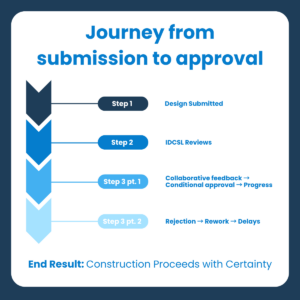
When an IDNO receives a design submission that isn’t quite right, they face a choice. They can simply respond with rejection and a request to rework and resubmit. Or they can take a more collaborative approach.
IDCSL chooses collaboration.
When designs are submitted, the focus is on helping businesses progress efficiently. Rather than just identifying problems, IDCSL provides solutions. This might mean offering conditional approval subject to specific changes, with clear guidance about what’s acceptable. It could involve suggesting alternative approaches that meet adoptable standards while working within project constraints.
The impact of this approach is significant. The moment an ICP receives design approval, they move out of the risk zone. Everything they’ve costed to their client becomes validated. The programme gains certainty. Construction can proceed confidently, knowing that fundamental changes won’t be required later. This collaborative approach to design approval clears the path for project delivery.
Legal Processes: Starting Early to Save Time
Property consents and legal agreements represent another potential bottleneck. Projects cannot energise until these elements are completed, making early action essential.
The traditional approach involves waiting for design approval before instructing legal work. This sequential process can add four to six weeks to the critical path. IDCSL takes a different approach by starting legal instruction the moment there’s a sketch – an indicative cable route on a plan showing the project’s broad approach.
At this early stage, IDCSL instructs Connections Legal Management with landowner solicitor details and the indicative route. CLM can then run title searches and identify who’s affected by the proposal. This parallel processing approach cuts legal timelines by half or more in most instances.
Unless designs change materially – which should be communicated through the collaborative design process – this early start saves considerable time on the critical path. It’s about understanding the sequence of work and finding ways to overlap activities that traditionally happened in series.
Onboarding: Eliminating Confusion Through Clear Communication
 One of the most common sources of friction in network adoption comes from unclear processes and uncertain expectations. Projects often appoint separate businesses – ICPs for construction, IDNOs for adoption – and simply expect them to communicate effectively without proper introduction or process clarification.
IDCSL takes a proactive approach to onboarding. When an ICP is appointed to deliver work, IDCSL reaches out immediately to introduce themselves as the adopting IDNO. This onboarding covers everything the ICP needs to know:
- How to submit designs
- What standards apply
- What the approval process looks like
- Who to contact for different issues
This approach extends beyond technical requirements. IDCSL arranges supplier agreements upfront, ensuring when the time comes to claim the asset value, there are no issues with invoicing or payment. Authorisations are completed early, so when the network is ready to energise, ICPs don’t face programme restrictions waiting for final approvals.
The goal is to remove ambiguity. Rather than leaving ICPs and clients to figure out who should be talking to whom and when, IDCSL makes the route clear from the outset. This is particularly important when clients aren’t working directly with ICPs, such as in EV projects where charge point operators often appoint the IDNO directly.
Payment: Transparency That Builds Trust
Late payment represents one of the biggest frustrations ICPs face when working with IDNOs. Projects reach energisation, but then payments are held back for unclear reasons or investment values are reduced without proper explanation.
IDCSL address this through transparency. Completion pack requirements are simple and clearly communicated. Rather than leaving ICPs guessing about what’s needed, IDCSL are developing an ICP focused project report aligned to critical path items with clear status. If something is outstanding, ICPs can see exactly what’s missing. No ambiguity and a clear route to invoicing asset value payments.
Further, the team regularly meets to review capital deployment based on current commitments and energisations, ensuring payments can be made promptly when due. This isn’t just good practice – it’s respect for the businesses that make projects happen.
Building Relationships Through Trust
IDCSL’s focus on building enduring relationships is evident throughout construction, where we work with ICPs to ensure quality control is captured through design and build.
We are not new to the unknowns, the unforeseen or the unexpected challenges during construction and choose to focus on solutions where these situations arise. This builds reciprocal respect, creates trust and allows us to create the relationships we have today.
By reducing friction during construction, projects progress more smoothly. ICPs can focus on delivery and relationships remain positive, benefiting everyone involved in both current projects and future collaborations.
Independent Validation
 IDCSL’s customer-focused philosophy isn’t just internal policy – independent research validates it. Baringa recently conducted customer interviews, surveying clients to understand their experiences working with the company.
The results validified IDCSL’s approach. Customers consistently highlighted the approachability and expertise of IDCSL’s team, alongside attentive relationship management prioritising frequent touchpoints and collaboration. They valued transparency around communication, asset value payments, and business processes.
As one Electrical Connections Manager summarised:
“They are very strong on the relationship management side, I feel like I am being supported as they are in contact a lot.”
When asked how likely they were to recommend IDCSL, feedback was consistently positive.
The Formula for Better Network Adoption
Asset values provide the foundation for any IDNO relationship. However, the difference between smooth adoption and frustrating adoption lies in everything that happens between signing and payment.
Through focusing on four key areas – collaborative design approvals, early legal instruction, clear onboarding, and transparent payment processes – IDCSL supports smoother project delivery. Combined with a trust-based approach to relationships, this creates an adoption experience that prioritises programme certainty and eliminates unnecessary friction.
Ready to experience a different approach to network adoption? Contact IDCSL to discuss your next project and discover how customer-focused adoption can support your programme delivery.